Frequently Asked Questions
Why is this project necessary?
The primary objective is to improve safety, traffic operations, and connectivity for motorists, bicyclists, and pedestrians within and surrounding the Old McHenry Road and Canadian National (CN) Railroad Crossing and along Quentin Road. The preferred alternative improves safety and capacity throughout the project area.
What kinds of improvements can we expect to see?
The planned improvements include a new roadway underpass grade separation at Old McHenry Road and the CN Railroad Crossing, intersection improvements and new traffic signals, additional through lanes, sidewalk and trail connections, improved crosswalks.
Please see this video that describes the Old McHenry Crossings proposed improvements.
When can I expect to see construction and what is the timeline?
The first construction contract will be for Old McHenry Road from Fairfield Road to Bonnie Lane and is expected to begin in 2029. As part of this contract, a new traffic signal will be installed at the intersection of Quentin Road and Highland Drive.
The remaining sections of the project will follow based on the availability of funding.
Please view the timeline for more information.
What are the project limits?
The study area generally includes the following:
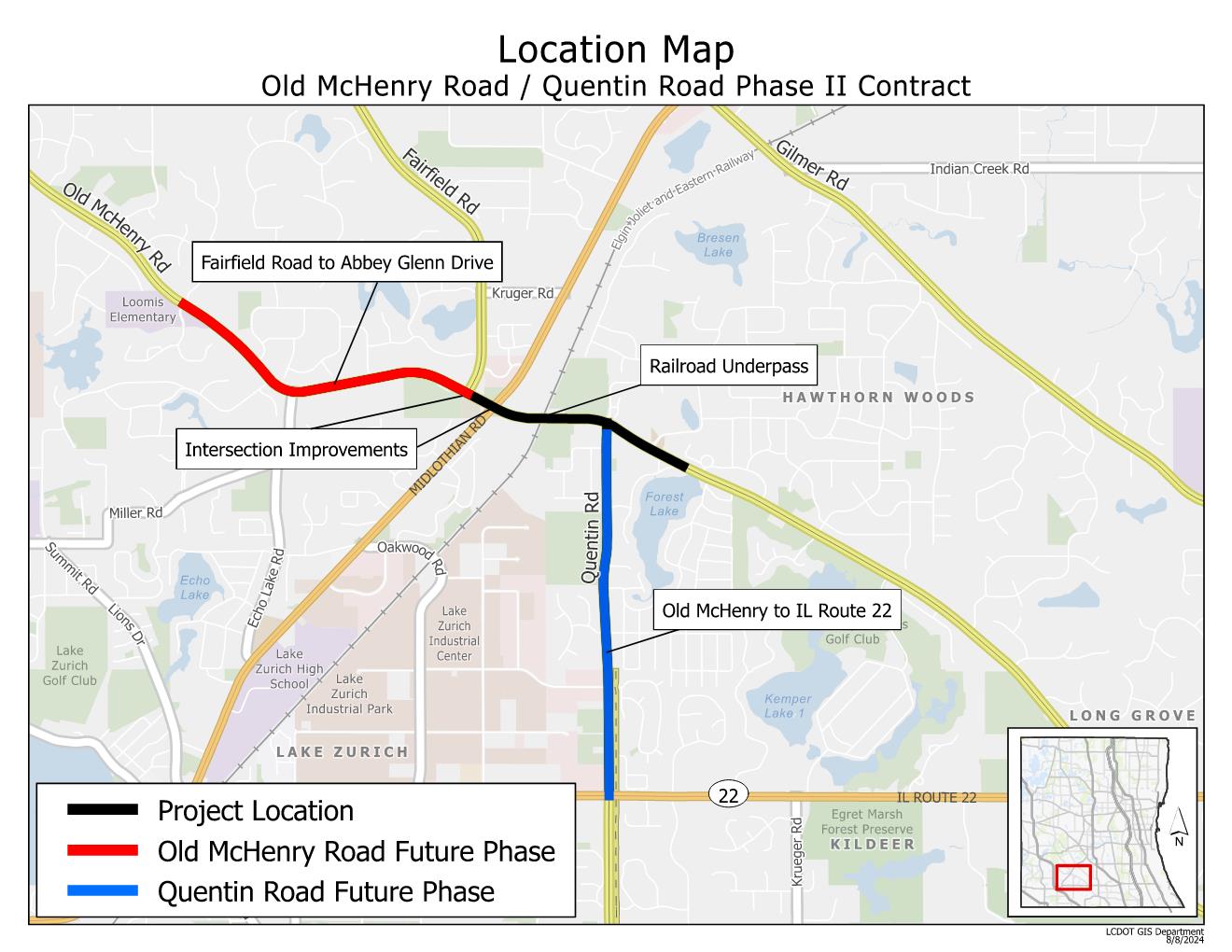
- Old McHenry Road, Abbey Glenn Drive to Bonnie Lane
- Quentin Road, IL Route 22 to Old McHenry Road
- IL-22, east and west of the Quentin Road intersection
- Midlothian Road, north and south of the Old McHenry Road intersection
- Fairfield Road, north of the Old McHenry Road intersection
- Echo Lake Road, south of the Old McHenry Road intersection
Please view the map for more information on the study area:

What are the key benefits to the project?
The benefits of the project include a reduction of travel time by 70% during the peak travel periods saving motorists $75 million in delay costs by 2050, improved emergency service response times, new pedestrian/bicycle connections to regional paths and destinations, and enhanced stormwater management and improved water quality.
What other improvements are proposed along Old McHenry Road?
The project limits along Old McHenry Road extend from Abbey Glenn Drive to Bonnie Lane. New traffic signals will be added at intersections with Echo Lake Road and the new entrance to St. Matthew Church and Hawthorn Woods Public Works to improve the flow of traffic turning onto or off of these side streets.
Intersection improvements are proposed at intersections with Fairfield Road, Midlothian Road, and Quentin Road, including additional turn lanes and updated traffic signal phasing. Old McHenry Road will be widened to 6 lanes from Fairfield Road to Midlothian Road to help reduce congestion in this area. A multi-use path is proposed along the north side of the roadway from Lagoon Drive Fairfield Road. More detailed exhibits and diagrams can be found on the public outreach tab under Public Information Meeting #3.
What improvements are proposed along Midlothian Road?
At the intersection with Old McHenry Road, Midlothian Road will be widened to include two through lanes in each direction, two dedicated left turn lanes, and a dedicated right turn lane on both Midlothian Road legs of the intersection. A multi-use path and sidewalk are also proposed along Midlothian Road from March Street to Commons Circle. More detailed exhibits and diagrams can be found on the public outreach tab under Public Information Meeting #3.
What improvements are proposed along Fairfield Road?
The intersection of Fairfield Road and Old McHenry Road will feature dual right turn lanes on westbound Old McHenry Road to northbound Fairfield Road. A multi-use path is proposed on the east side of the roadway from Old McHenry Road to Kruger Road. More detailed exhibits and diagrams can be found on the public outreach tab under Public Information Meeting #3.
What improvements are proposed along Quentin Road?
The proposed design for Quentin Road includes 5 lanes from IL 22 to Highland Drive, and 3 lanes from Highland Drive to Old McHenry Road. In both sections, the middle lane will be a left turn lane or two-way shared left turn lane, which will allow drivers to safely slow down before turning onto a side street without slowing the flow of traffic on Quentin Road. A new traffic signal will be installed at Quentin Road and Highland Drive, and a multi-use path is proposed on the west side of the roadway from Ensell Road to Old McHenry Road. An existing path is located on the east side of the roadway continuing south from Ensell Road, providing connectivity to the IL 22 intersection. More detailed exhibits and diagrams can be found on the public outreach tab under Public Information Meeting #3.
Are any new traffic signals being installed as part of the project?
Yes – new traffic signals will be installed at the following intersections: Old McHenry Road at Echo Lake Road, Old McHenry Road at the new St. Matthew Church Entrance/Hawthorn Woods Public Works Entrance, and Quentin Road at Highland Drive.
This is a big project. How is it being split up?
The project will be split up into three sections. The first section along Old McHenry Road extends from Fairfield Road through Bonnie Lane. This includes roadway reconstruction, underpass construction, and St. Matthew Church parking lot reconstruction. A new traffic signal will also be installed at the intersection of Quentin Road and Highland Drive as part of this section. The second section includes the resurfacing of Old McHenry Road from Abbey Glenn Drive to Echo Lake Road, and the reconstruction of Old McHenry Road from Echo Lake Road to Fairfield Road. The third section includes the remainder of the Quentin Road improvements.
How is this project funded?
Engineering is underway and is funded through a combination of various Lake County and Illinois funding sources. LCDOT has received a commitment for $12 million in Illinois Commerce Commission (ICC) funding for construction. At this time, construction costs are not yet funded. LCDOT anticipates applying for federal grants and Surface Transportation Program (STP) funding to support future phases of engineering and construction.
 Old McHenry Crossings